Science
Crystal Formation That Took a Roundabout Route at 950°C Now Happens Directly at 750°C in Under a Minute by First Breaking the Raw Material Apart (Institute of Science Tokyo)
Related terms: 化学 結晶 熱膨張 BiNi1-xFexO3
Key points (reviewing AI explanation)
Institute of Science Tokyo announced a method for directly producing BNFO, a material that shrinks when heated, from a raw material that, like glass, has no crystal structure. The conventional multi-step reaction at about 950°C now crystallizes at 750°C in under a minute, and particle size also decreased from about 15 to about 5 micrometers.
Explanation
Specially Appointed Assistant Professor Takumi Nishikubo of Institute of Science Tokyo (Research Center for Autonomous Systems Materialogy, Institute of Integrated Research) and colleagues announced a method for directly producing the bismuth-nickel-iron-oxygen material BiNi1-xFexO3 (BNFO) at a lower temperature and in a shorter time than before (published August 28, 2026).
Conventionally, raw materials consisting of multiple crystals were heated to about 950°C, and the reaction proceeded as elements moved from particle to particle. This was, so to speak, a roundabout method of production that passed through numerous other substances before reaching the target crystal.
In the new method, a raw material is first prepared in which bismuth, nickel, and iron are uniformly mixed at the atomic level and which, like glass, has no crystal structure. As a result, the target crystal appeared directly at 750°C without passing through multiple intermediate substances, and crystallization was completed in under one minute. Instead of reacting at high temperature for a long time to break down and rebuild the crystal structure, the roundabout route in material production was eliminated by breaking the raw material apart in advance. Because the heating time was shortened, particle growth was suppressed, and particle size decreased from about 15 micrometers to about 5 micrometers.
BNFO is one of the materials that possess the property of "negative thermal expansion," meaning it shrinks rather than expands when heated. Even when produced by the new method, the degree of shrinkage upon heating is preserved, and the material now shrinks gradually over a wider temperature range than before. Because mixing such materials into other materials can cancel out expansion caused by temperature changes, applications are expected in materials that prevent slight misalignment in precision instruments, and in composite materials made by blending fine negative-thermal-expansion material into resins and the like.
Published paper: DOI 10.1021/jacs.6c04051
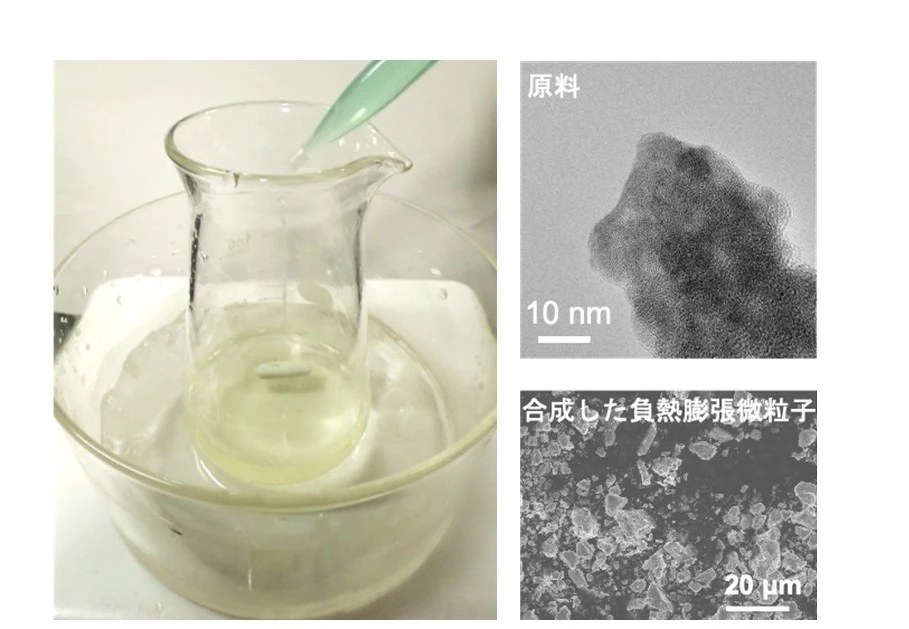
Figure source: www.isct.ac.jp(画像提供:西久保匠特定助教) ※ Reproduced as in the original (quotation)
Source: www.isct.ac.jp