Science
Irregular Galaxy Arp 263, About 25 Million Light-Years Away, Newly Imaged in Infrared by Webb (ESA/Webb)
Key points (reviewing AI explanation)
On August 27, 2026, ESA released an image of the irregular galaxy Arp 263 (about 25 million light-years away), captured by the Webb Space Telescope. Misalignment between the galaxy's stars and gas suggests it is the trace of a past galaxy merger.
Explanation
On August 27, 2026, the European Space Agency (ESA) released, as its "Picture of the Month," an image of the irregular galaxy Arp 263 (NGC 3239) captured by the James Webb Space Telescope's Near-Infrared Camera (NIRCam).
Arp 263 lies in the direction of the constellation Leo, at a distance of "about 25 million light-years" from Earth. Discovered in 1784, it is one of the irregularly shaped galaxies included in the "Atlas of Peculiar Galaxies" compiled by American astronomer Halton Arp in 1966.
The new image shows numerous star clusters and several regions where new stars are being born. In the most active star-forming region, curving, compact star clusters are strung together like a chain, leading to the largest and brightest star-forming nebula. Because the orientation of the galaxy's stars and gas is misaligned, different parts of the gas move at different velocities, and new stars are being born widely across the galaxy, Arp 263 is thought to be the result of a past merger with another galaxy. Comparisons have also been made with a Hubble Space Telescope image released in 2023.
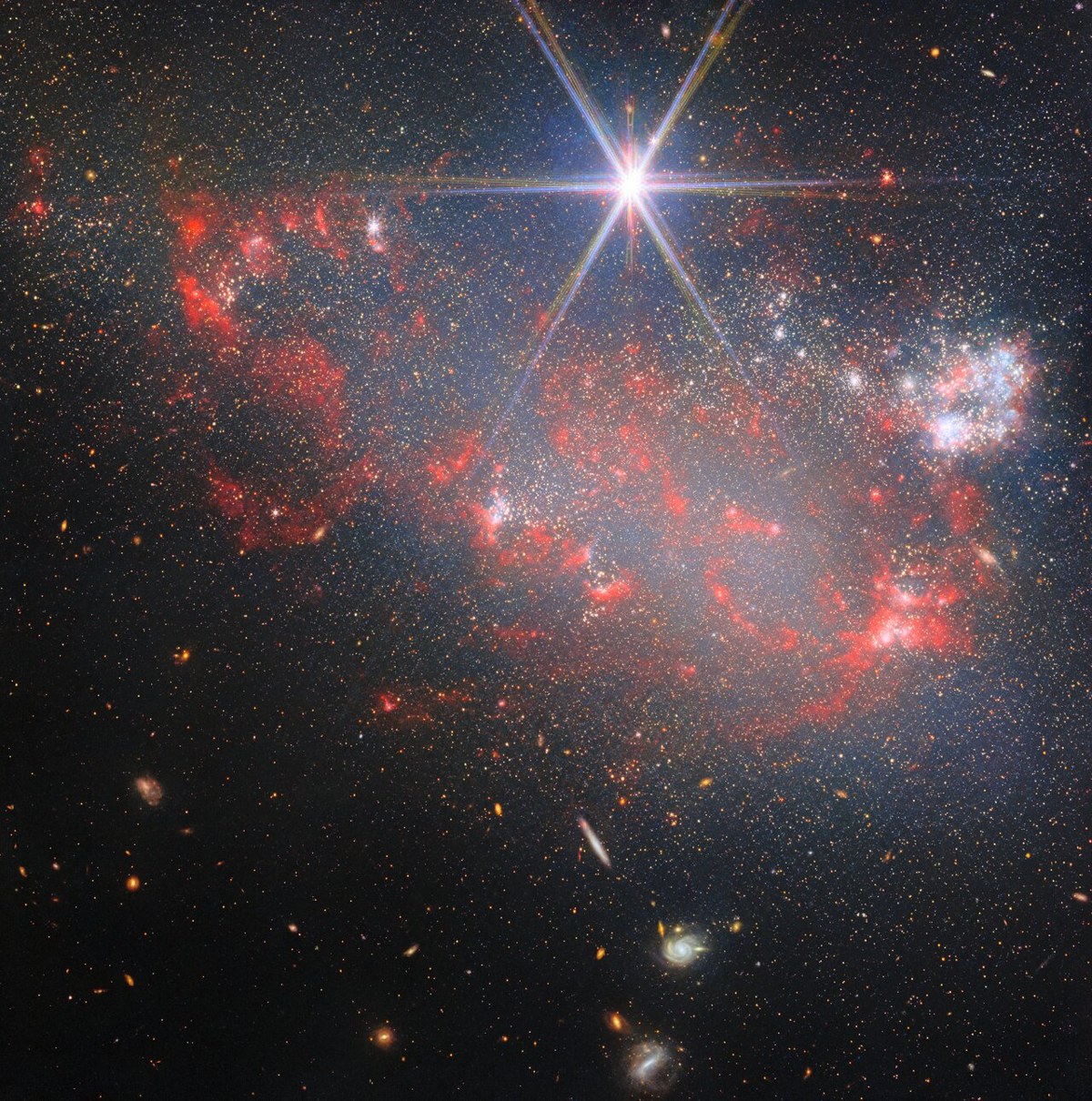
Figure source: esawebb.org(Credit: ESA/Webb, NASA & CSA, A. Leroy) ※ Reproduced as in the original (quotation)
Source: esawebb.org