Science
About 7 Months After Launch, NASA's Exoplanet-Exploring Satellite Pandora Begins Observations (NASA)
Key points (reviewing AI explanation)
On August 25, 2026, NASA announced that its exoplanet-exploring satellite Pandora had begun scientific observations. Over one year, it plans to observe at least 20 exoplanets, each 10 times for 24 hours per observation.
Explanation
On August 25, 2026, NASA announced that the exoplanet-exploring satellite Pandora had begun scientific observations. Pandora was launched into low Earth orbit on "January 11" of the same year, so observations began about 7 months later.
Pandora is a small satellite equipped with an all-aluminum telescope "about 18 inches (45 centimeters)" in diameter, and it is the first mission in NASA's new Astrophysics Pioneers satellite program. It carries a detector capable of observing visible and near-infrared light simultaneously, and it is designed to distinguish signals from an exoplanet's atmosphere from signals caused by the host star's own activity.
During its primary mission period of "1 year," Pandora plans to conduct long-duration observations lasting 24 hours each, "10 times" per target, on "at least 20" exoplanets. These observations will examine whether the planets' atmospheres contain haze, clouds, or water.
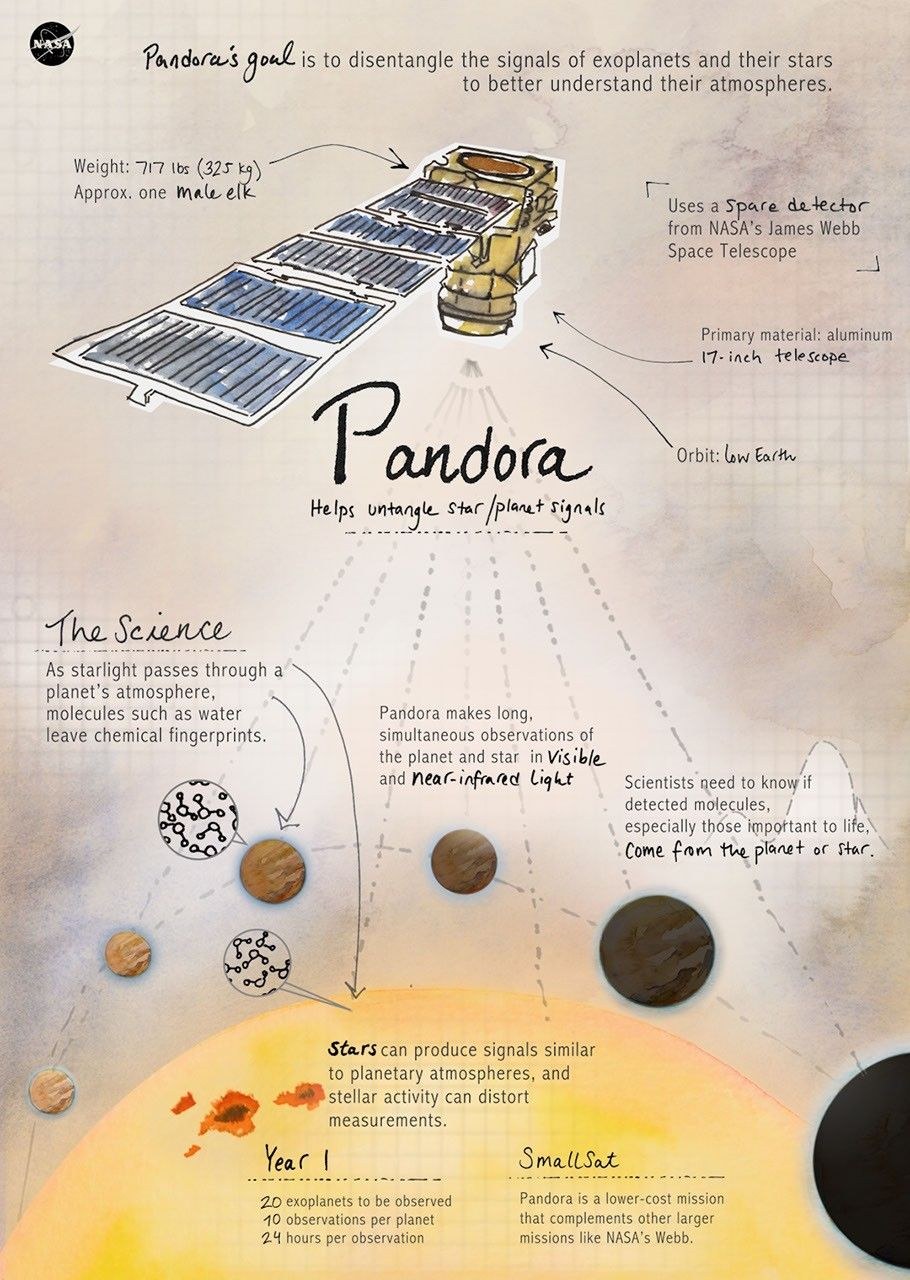
Figure source: science.nasa.gov(Credit: NASA/Sophia Roberts) ※ Reproduced as in the original (quotation)
Source: science.nasa.gov