Science
DNA Rebuilds Its 3D Structure Before Replication Begins: Confirmed by Tracking Chromosome 6 in Individual Cells (RIKEN, Kyoto University)
Key points (reviewing AI explanation)
On August 10, 2026, RIKEN and others announced that the reconstruction of DNA's three-dimensional structure within the cell nucleus governs the initiation of DNA replication. By increasing and decreasing the protein GINS4, the team confirmed the relationship between the degree of structural recovery and the timing of replication initiation.
Explanation
On August 10, 2026, a joint research team from RIKEN, Kyoto University, and the Japan Science and Technology Agency (JST) announced that the three-dimensional structure DNA reforms within the nucleus after cell division plays an important role in initiating the next round of DNA replication.
Within the cell nucleus, mammalian DNA is divided into two regions: the transcriptionally active "A compartment" and the transcriptionally suppressed "B compartment." This structure is lost once with every cell division and is reconstructed before the next round of DNA replication begins. The research team identified a protein called GINS4 as the factor responsible for this reconstruction, and conducted experiments artificially depleting GINS4 in the 30–120 Mb region of chromosome 6.
When GINS4 was depleted, abnormalities occurred in the formation of the B compartment, and cells appeared that were unable to initiate DNA replication. When GINS4 was allowed to accumulate again, replication began in cells whose B compartment structure had partially recovered. Using a technique that examines the progress of DNA replication in individual cells (scRepli-seq), the team compared 7 normal cells with 8 partially recovered cells and confirmed that the timing of replication initiation changed according to the degree of structural recovery.
Published paper: DOI 10.1038/s41467-026-75264-6
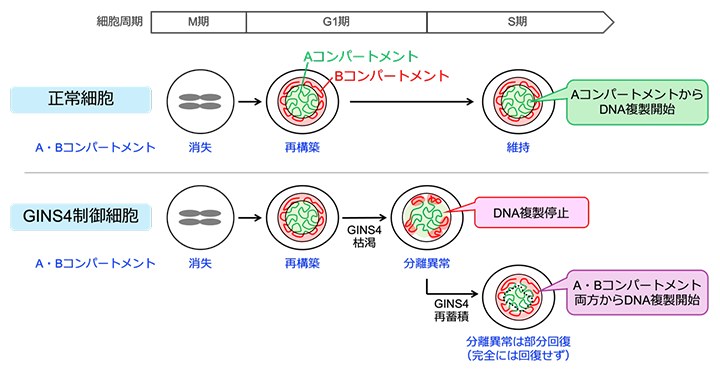
Figure source: www.riken.jp(画像提供:理化学研究所) ※ Reproduced as in the original (quotation)
Source: www.riken.jp