Science
2024 Marine Heatwave Fully Bleached 38% of Sesoko Island's Coral; Living Coral Area Fell from 22% to 6% (University of Tokyo)
Key points (reviewing AI explanation)
On August 25, 2026, the University of Tokyo and others announced that the record marine heatwave of 2024 caused coral bleaching nationwide, from Okinawa to Honshu. Coral that had spread northward was also affected, indicating that temperate waters may not serve as a 'refuge.'
Explanation
On August 25, 2026, a research group including the University of Tokyo, University of the Ryukyus, and Tohoku University announced that the record-breaking marine heatwave that struck waters around Japan in 2024 caused coral bleaching nationwide, from Okinawa to the coasts of Honshu.
The research team examined coral conditions at coastal sites along the Kuroshio and Tsushima Currents, ranging from Okinawa Island (Sesoko Island) and Ishigaki Island (Shiraho Coast) to Tatsukushi in Kochi Prefecture, Kushimoto in Wakayama Prefecture, Tsushima in Nagasaki Prefecture, and Tagojima and Numazu in Shizuoka Prefecture. The Degree Heating Weeks (DHW) index, which indicates the cumulative amount of heat stress corals experienced, reached 19.1 at Tsushima, 18.7 at Tagojima, and 17.2 at Numazu, exceeding 12.0 even at Tateyama.
At Sesoko Island (DHW = 8.6), 38% of the coral was completely bleached, and the area occupied by living coral in these waters fell from 22% to as low as 6%. Because tropical coral that had extended its range into temperate waters via the Kuroshio Current was also strongly affected by this heatwave, the research team points out that temperate waters may not necessarily serve as a safe refuge for coral.
Published paper: DOI 10.1038/s41598-026-65095-2
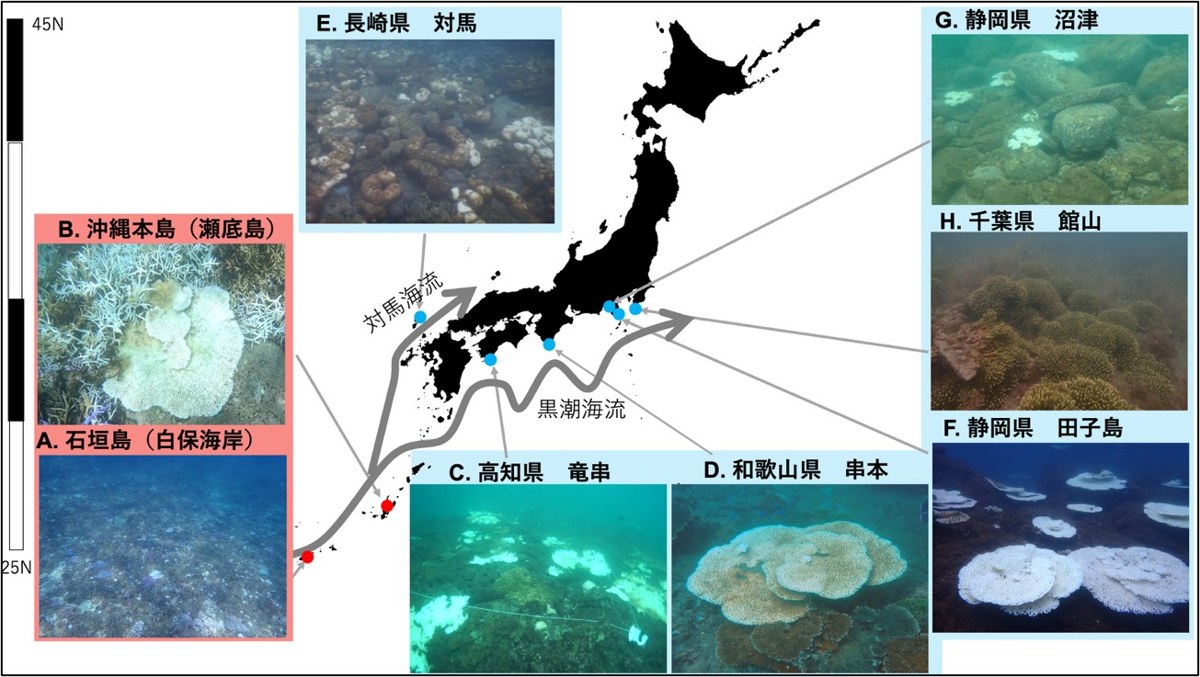
Figure source: www.a.u-tokyo.ac.jp(画像提供:東京大学大学院農学生命科学研究科) ※ Reproduced as in the original (quotation)
Source: www.a.u-tokyo.ac.jp