Science
Treating Two Adjacent Atoms as a 'Double Slit,' Researchers Observe Electron Interference Fringes at a 136 pm Spacing (University of Tokyo)
Key points (reviewing AI explanation)
On August 20, 2026, the University of Tokyo and others announced that they observed electron-beam interference fringes by treating two adjacent atoms in a silicon crystal as a 'double slit.' The slit spacing, 136 pm, was about 7 orders of magnitude smaller than in Young's experiment.
Explanation
On August 20, 2026, a research group including the University of Tokyo Graduate School of Engineering announced that it had used two adjacent atoms within a crystal as a "double slit" and observed electron-beam interference fringes at the atomic scale.
In the 19th century, British physicist Thomas Young showed that passing light through two slits produces a pattern of bright and dark stripes (interference fringes). The slit spacing in Young's experiment was about 1 mm. The research team directed a narrowly focused electron beam from a scanning transmission electron microscope (STEM) onto a silicon crystal, using two rows of atoms spaced 136 pm apart as a "double slit." This double slit is about 7 orders of magnitude (one ten-millionth) smaller than the one in Young's experiment.
By averaging the patterns from 356 equivalent atom pairs, clear interference fringes appeared, including bright fringes up to the third order. Calculations that assumed neighboring atoms vibrate independently caused the higher-order interference fringes to disappear, and the experimental results could not be reproduced unless the atoms were assumed to vibrate thermally in a coordinated manner. These interference fringes could be observed even when heated to 900 K (about 627°C), and applications are expected in the thermal design of semiconductors.
Published paper: DOI 10.1038/s41586-026-10914-9
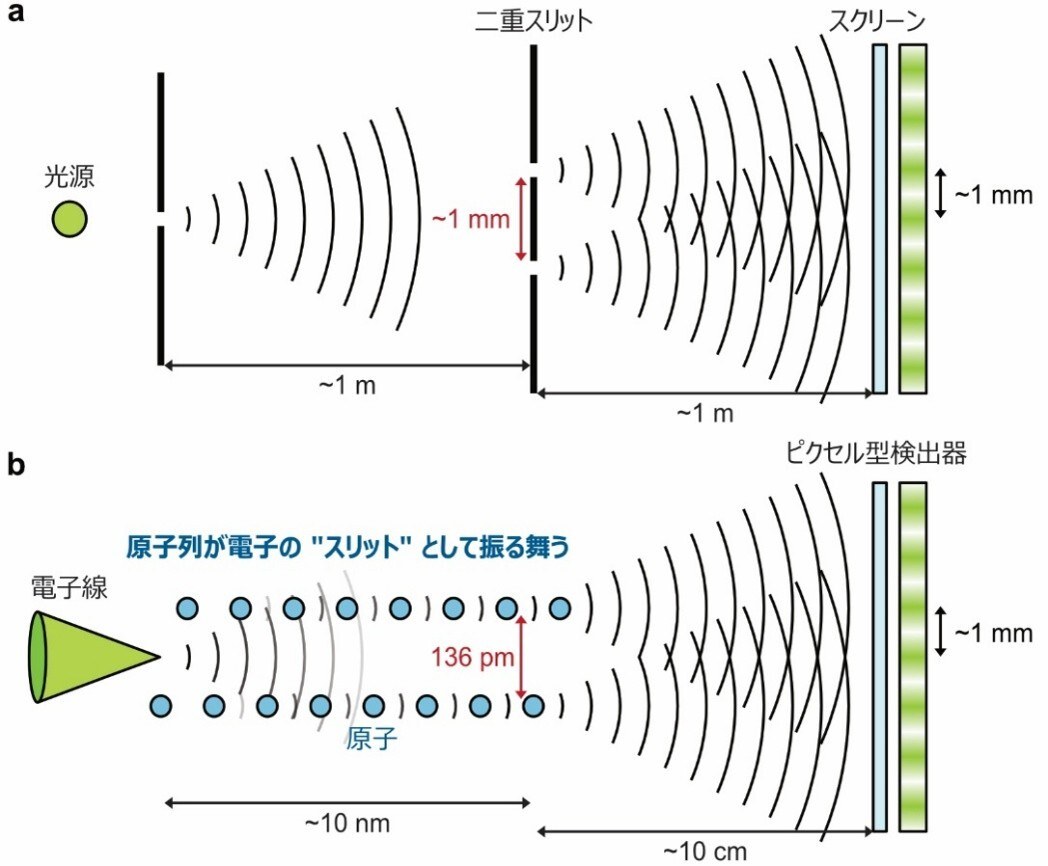
Figure source: www.t.u-tokyo.ac.jp(画像提供:東京大学大学院工学系研究科) ※ Reproduced as in the original (quotation)
Source: www.t.u-tokyo.ac.jp