Science
Nanographene Synthesized from Polycyclic Aromatic Compounds in a Two-Step Reaction, Linking 8 to 10 Rings (RIKEN)
Key points (reviewing AI explanation)
On August 26, 2026, RIKEN and Nagoya University announced a method for synthesizing complex nanographene in just two reaction steps. Molecules with 8 to 10 fused rings can be produced with structures ranging from flat to curved.
Explanation
On August 26, 2026, a research group from RIKEN and Nagoya University announced a method for synthesizing structurally complex nanographene in just two reaction steps.
Nanographene is a type of polycyclic aromatic hydrocarbon (PAH) that resembles a piece cut out from graphene, in which carbon atoms are connected in a honeycomb pattern; it is a material expected to find applications in organic ELs and organic solar cells, among other uses. The research team developed a "two-step APEX method" that combines palladium-catalyzed "direct arylation" with "oxidative cyclization."
With this method, nanographenes made up of 8 to 10 fused rings can be synthesized in just two reaction steps, and the products emit light at wavelengths of 440 to 570 nanometers (nm), with some glowing orange with a peak maximum at 576 nm. It was also confirmed that incorporating five- or seven-membered rings makes it possible to create curved structures with "negative curvature," tilted 34.8 degrees from planar. This method now allows a variety of nanographenes, from flat to curved, to be selectively produced in fewer steps than before.
Published paper: DOI 10.1002/anie.2205198
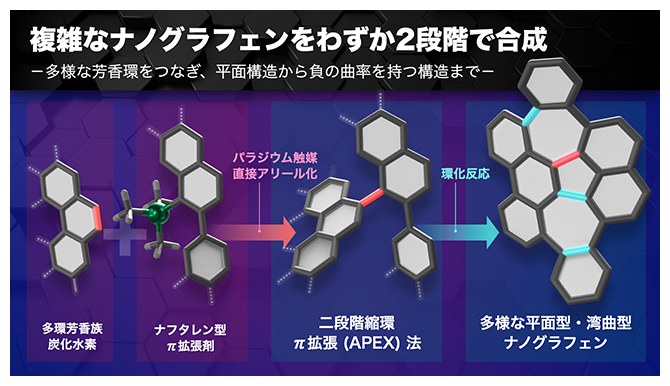
Figure source: www.riken.jp(画像提供:理化学研究所(作成:Dr. Issey Takahashi)) ※ Reproduced as in the original (quotation)
Source: www.riken.jp