Science
Wasabi and Arabidopsis Halleri Use Three Genes to Distinguish Temperature Memories Spanning Days to About 5 Months (University of Tsukuba)
Key points (reviewing AI explanation)
On August 21, 2026, the University of Tsukuba and others announced the mechanism of a 'seasonal meter' by which plants predict the flowering season from temperature memory. In wasabi and Arabidopsis halleri, three genes carried temperature memories of different lengths: a few days, several weeks, and about 5 months.
Explanation
On August 21, 2026, a research group from the University of Tsukuba, Kyoto University, and Gifu University announced the mechanism of a "seasonal meter" by which plants predict the season from temperature memory and determine their flowering time.
The research team surveyed and compared two species, wasabi (Eutrema japonicum) and Arabidopsis halleri, in the field over a two-year period. As a result, they found that three genes involved in flowering each carry a temperature memory of a different length: a few days, several weeks, and about 5 months, respectively.
The gene responsible for short-term memory responds to recent temperature changes, while the gene responsible for long-term memory responds to the progression of winter cold across seasons; by combining multiple "clocks," plants are thought to be able to predict the flowering season from temperature data alone. Once this mechanism is understood, it may become possible to predict plant gene activity and flowering time from temperature records alone.
Published paper: DOI 10.1371/journal.pone.0336733
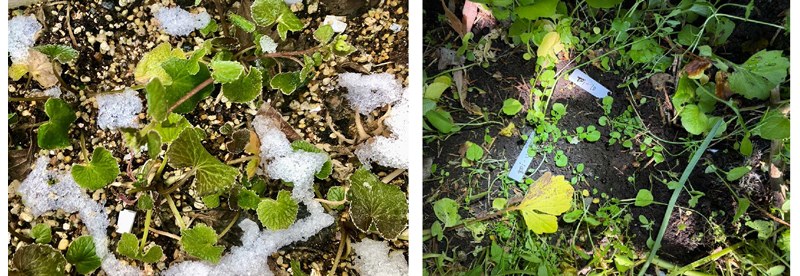
Figure source: www.kyoto-u.ac.jp(画像提供:筑波大学) ※ Reproduced as in the original (quotation)
Source: www.kyoto-u.ac.jp